That shelf is quietly eating ₹3 lakhs a year
Dead stock doesn't announce itself. It sits there, looking like inventory, until the expiry date passes and the write-off is filed. ShelfLifePro runs your sales pace against every batch's expiry and flags the stock that won't clear in time, valued in money, while markdown, transfer, and flash-sale are still on the table.
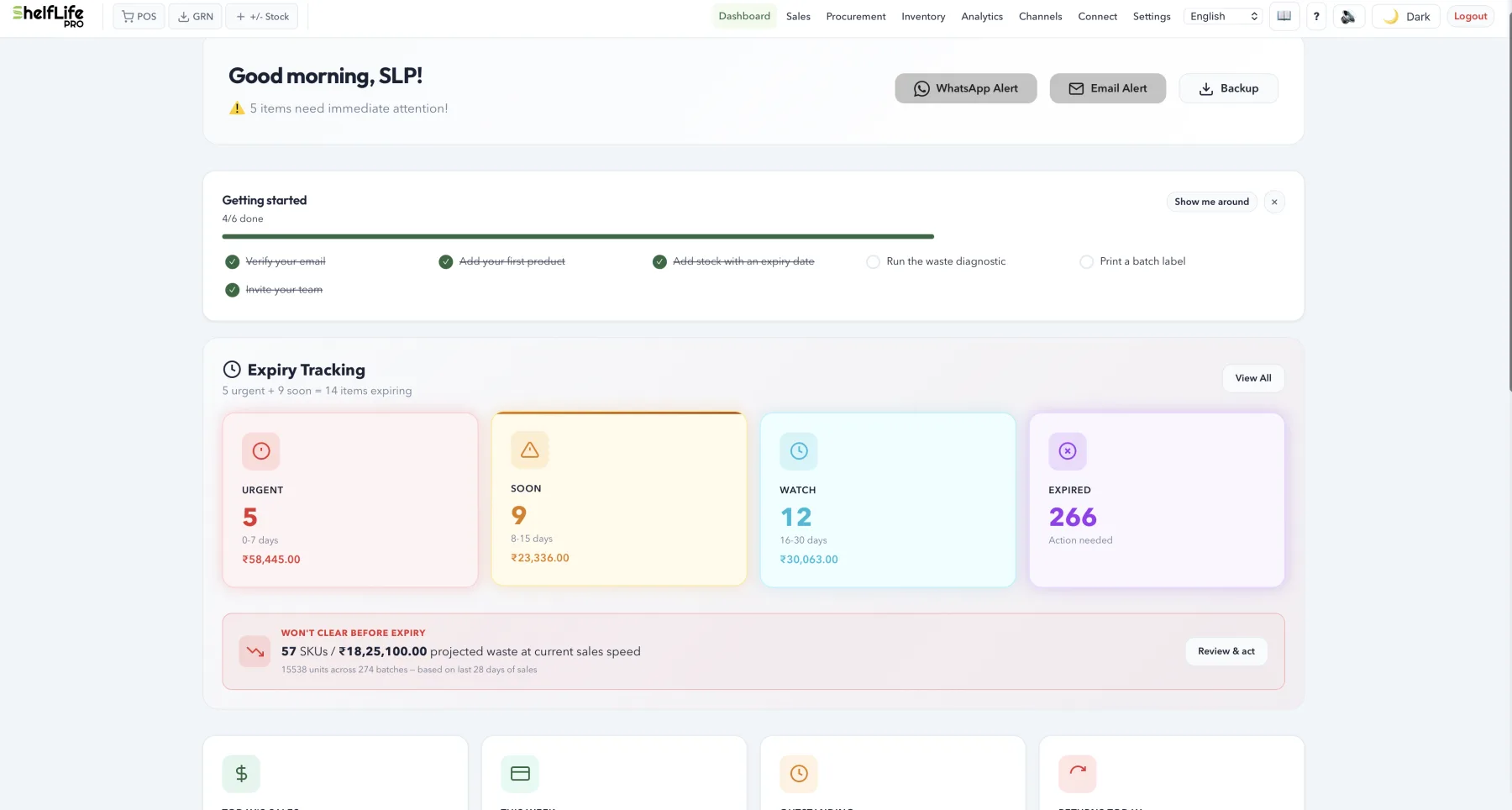
Dead stock announces itself here
The dashboard runs every batch against its sales pace and puts the projected waste, in money, where you can't miss it.
The math nobody does (until the auditor makes them)
That ₹200 product sitting on your shelf for 6 months doesn't cost ₹200. It costs:
You paid ₹200. You lost ₹430. And that's one SKU. The average store has 150-300 slow-moving SKUs doing this simultaneously.
Shelf Space Cost
Every product occupies space that could hold something that sells. At an average shelf cost of ~₹3/month/product, 200 slow movers cost you ₹600/month in opportunity cost alone. That is ₹7,200/year, on products generating near-zero revenue.
Capital Cost
Money in dead stock is money not buying products that sell. If you borrowed from your distributor at 12% annual, every ₹1 lakh in dead stock costs you ₹1,000/month in interest. Even if you paid cash, that capital has an opportunity cost, it could be earning 8-10% in a fixed deposit instead of depreciating on your shelf.
Disposal Cost
When products expire, you do not just lose the product cost, you lose double. The product itself (₹200) plus the cost of disposing it responsibly (time, labor, compliance documentation). Some categories like pharma have mandatory disposal processes that add another 10-15% in compliance cost.
Velocity-based detection, not arbitrary rules
Most inventory systems flag “dead stock” as “hasn't sold in 90 days.” That's a rear-view mirror. ShelfLifePro uses velocity analysis: it tracks the rolling sales rate of every product and detects deceleration. A product selling 10 units/week that drops to 2 units/week is flagged at week 3, not week 13. The difference between those two timelines is the difference between a 15% markdown and a 100% write-off.
Velocity tracking
Every product gets a rolling 30-day sales velocity. The system knows what "normal" looks like for each item. Dettol sells 40 units/week in your store. Amul Butter sells 8. Both numbers are "healthy", what matters is the trend, not the absolute.
Deceleration alerts
When velocity drops below 40% of the 90-day average, you get an alert. The product is slowing, not dead yet, but heading there. This is the window where you can still do something useful. After this window closes, your options shrink to "write it off" and "feel bad about it."
Action recommendations
Based on days to expiry and current velocity, the system recommends: markdown now, create a bundle, return to vendor, or hold. Seasonal products get different treatment, sunscreen in February is not dead stock, it is waiting for its moment.
Prevention vs. discovery
Two stores, same problem, different timing. The math tells the story.
Finding dead stock
Reactive, quarterly audit
You discover 200 expired products during quarterly audit.
Products are expired. Vendor won't take them. Customers won't buy them. The only option is the bin.
Preventing dead stock
Proactive, 6-8 weeks early
System alerts you to 200 decelerating products 6-8 weeks before expiry. Actions taken:
Net recovery: ₹72,000 of that ₹1.2 lakh
Same 200 products. Same ₹1.2 lakh at risk. Recovery difference: ₹72,000
The only variable was timing, 6 weeks of lead time turns a write-off into a recovery.
Four things you can do before stock dies
Each action has a different recovery rate. The system recommends the right one based on the math.
Smart Markdown
The system suggests an optimal discount based on days-to-expiry and current sales velocity. Deep enough to actually move the product, shallow enough to protect your margin. A product with 30 days left and declining velocity gets 15% off. A product with 7 days left and zero velocity gets 40% off. The math is specific to each SKU, not a blanket "put everything on 20% off" approach.
Auto-Bundle
Pairs slow movers with fast movers. "Buy the popular Himalaya Shampoo, get the slow-moving Himalaya Conditioner at 40% off." You move both products: the customer gets a deal, you recover margin on the slow mover, and the fast mover sells itself anyway. The system identifies which pairings make sense based on category affinity and purchase history.
Vendor Returns
If the product is within the return window, the system generates the return documentation automatically, batch numbers, quantities, purchase dates, invoice references. It tracks the claim status too. Because the hardest part of returning products to your distributor is not the decision, it is assembling the paperwork before the window closes.
Donate & Deduct
For items past the return window but before expiry. The system generates donation documentation for tax deduction purposes. Section 80G eligible donations are tracked with recipient details, item values, and dates. You lose the product, but you recover 30-35% of the value as tax benefit. Better than 0% from the bin.
Frequently asked questions
The questions people ask once they stop pretending dead stock is not a problem
Dead stock is a prevention problem, not a discovery problem
Start your free trial. See which products in your store are decelerating, before they become write-offs.