Claim or lose: return near-expiry stock to the company before the window closes
ShelfLifePro is agri input shop software for India's seed, pesticide and fertiliser dealers — it tracks each company's return window per batch, shows the value at risk in ₹, and raises the debit note when stock goes back.
No credit card required. Cancel anytime.
Return before the window closes
Expired crop protection and seed cannot legally be sold — so unlike a grocery store, an agri dealer cannot discount their way out of near-expiry stock. The only move that saves the money is returning it to the company in time and claiming the credit. ShelfLifePro treats that as the rule, not an option.
Every claim on this page is a screenshot, not a promise
Live product, real demo data — this is what your counter looks like in ShelfLifePro.
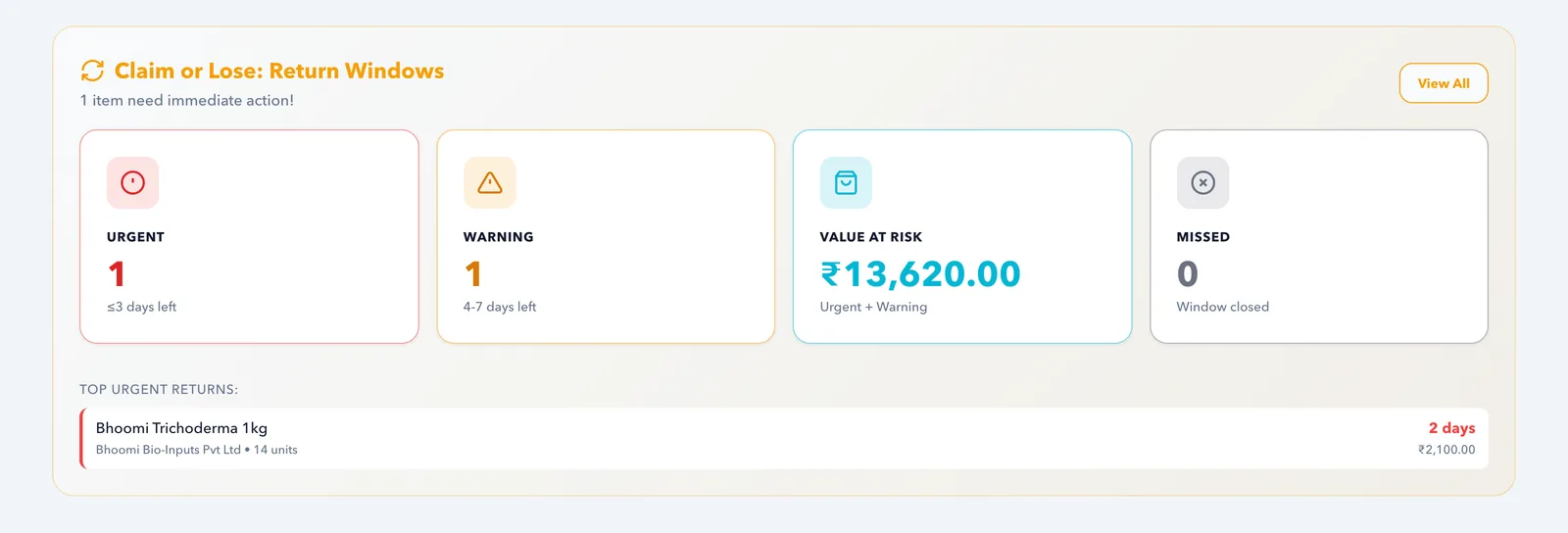
Every company's return window, with the ₹ at risk
The dashboard leads with the number that matters: how much stock misses its return window if you do nothing this week. ₹13,620 at risk, one claim urgent at 3 days left — and a missed counter whose only good value is zero.
- Return window tracked per company and per batch
- Value at risk in ₹, with urgent and warning claims flagged
- The missed counter is the score — the goal is zero
- Top urgent returns named, with days left to act
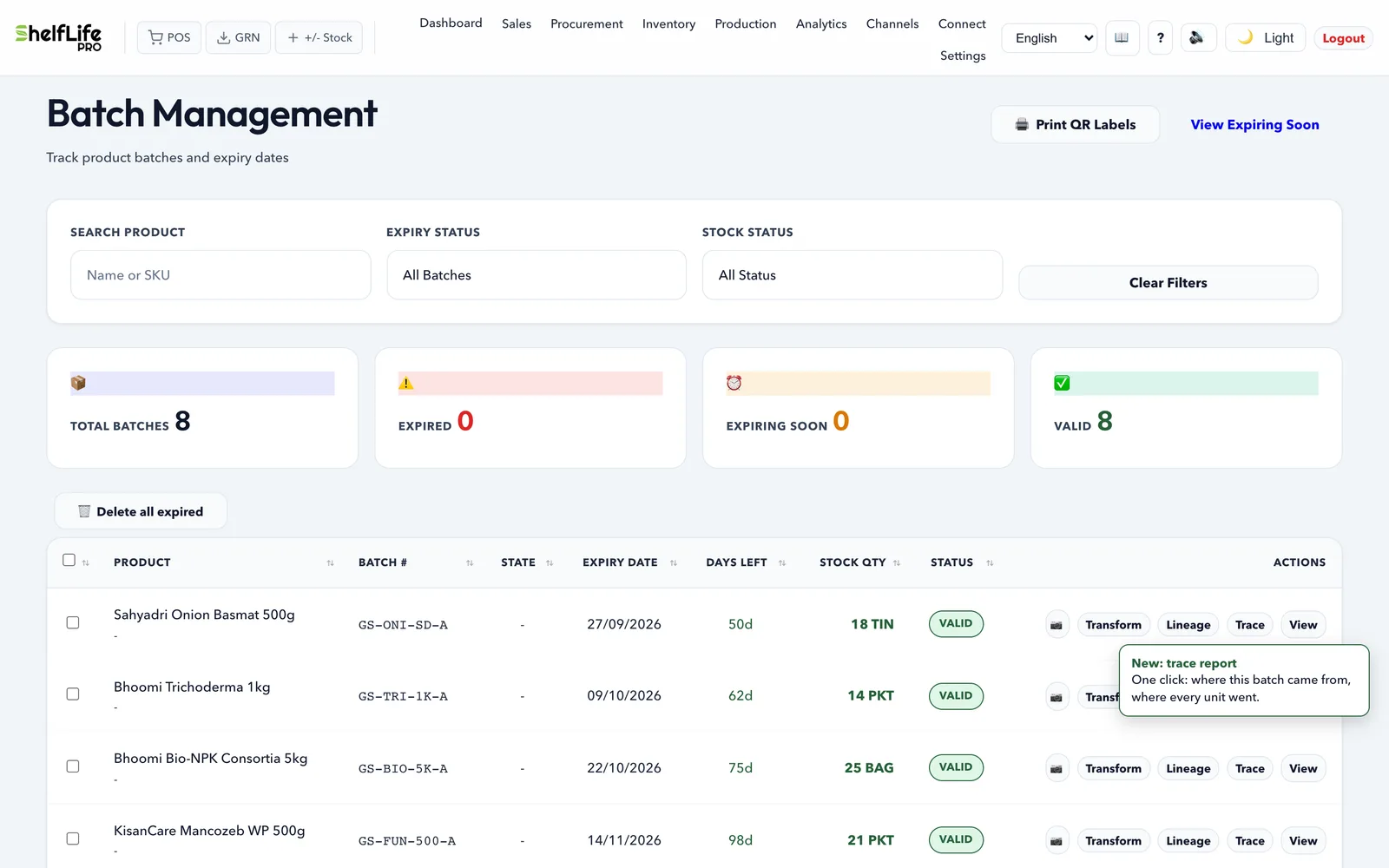
Every lot is a batch with a countdown — and a trace
Batch number, expiry date and a days-left countdown on every lot, valid versus expiring at a glance. One click traces where a batch came from and where every unit went.
- Batch number and expiry date on every lot
- Days-left countdown with valid vs expiring status at a glance
- One-click trace: where the batch came from, where every unit went
- Products carry their MRP for clean, compliant billing
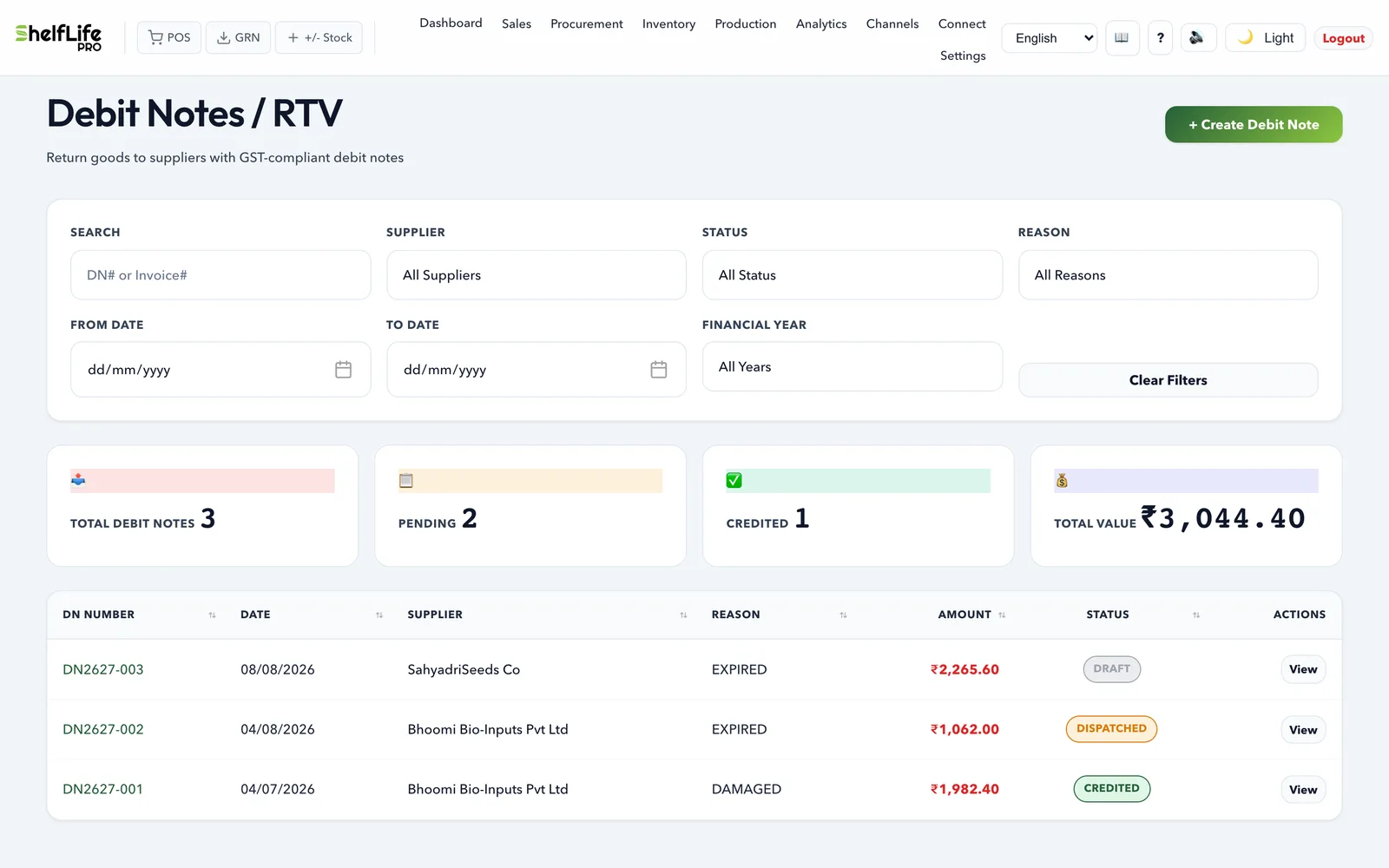
Debit notes to the company, GST-compliant
When stock goes back, the paperwork exists: a debit note per return with supplier, reason and status — pending until the company credits it, tracked to the rupee.
- GST-compliant debit notes for every return to the company
- Pending vs credited status on every note
- Total value tracked — you know what the company still owes you
- Filter by supplier, reason and financial year
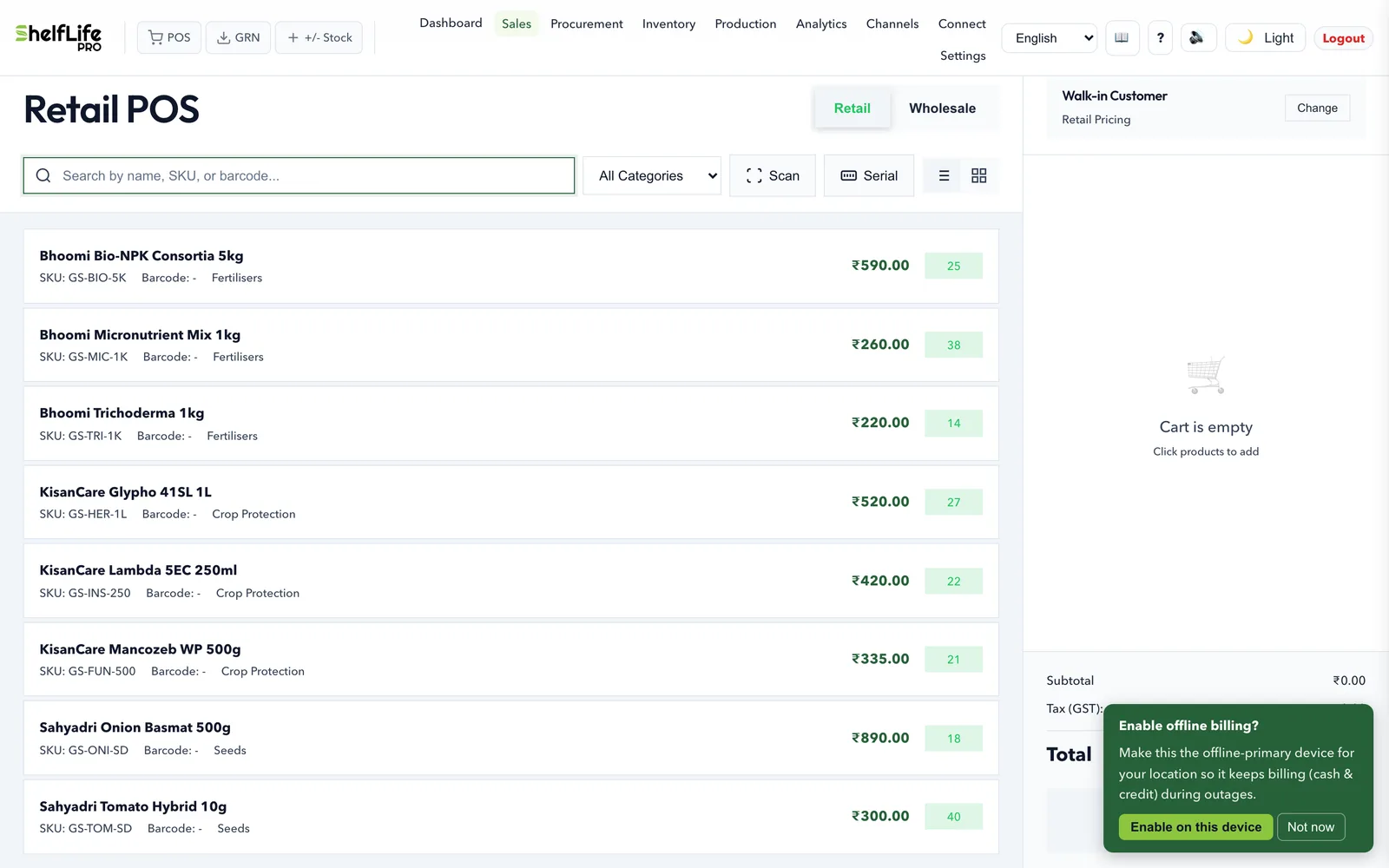
A real counter needs a real POS
Agri dealers sell across a counter, so this ICP keeps a POS: seeds, crop protection and fertilisers with batch-aware stock, GST billing, farmer credit — and offline billing for power cuts.
- Catalogue by category: seeds, crop protection, fertilisers
- Batch-aware stock counts at the counter
- Cash, UPI and farmer credit
- Offline billing keeps the counter running through a power cut
Questions agri input dealers ask
Straight answers about return windows, batches and the counter.
How do I claim expiring pesticide stock back from the company?
Each company gives you a return window — a period before expiry in which stock can go back for credit. ShelfLifePro tracks that window per company and per batch, flags claims as urgent when days are running out, and raises the GST-compliant debit note when you send stock back.
What happens if I miss the return window?
The stock becomes your loss: it cannot legally be sold after expiry, and the company will no longer take it back. That is why the dashboard leads with value at risk in rupees and a missed counter — the whole point is that the missed counter stays at zero.
Why not just discount near-expiry inputs like a grocery store?
Because expired crop protection and seed cannot legally be sold, and discounting toward the expiry date just accelerates stock into a dead end. For an agri dealer the correct action is return-to-vendor before the window closes — so that is the action the product pushes, not markdowns.
Does it handle billing at the counter — seeds, pesticides and fertiliser together?
Yes. Agri dealers keep a counter, so there is a full POS: your catalogue with categories for seeds, crop protection and fertilisers, batch-aware stock counts, GST billing, and offline billing so a power cut does not stop sales.
Can I bill farmers on credit?
Yes — customer accounts with credit are supported at the counter, alongside cash and UPI. Outstanding amounts show up on the dashboard so season-end collections are a list, not a memory exercise.
Does it track batches and expiry the way an inspector would want to see them?
Every lot is a batch with its number, expiry date and days-left countdown, and a one-click trace shows where the batch came from and where every unit went. Products carry their MRP, and the paper trail for returns lives in the debit-note module.
Put your return windows on a board this week
Set up in a day. Enter your near-expiry lots first — the first claim you save usually pays for the year.